Your Guide To Eclipses
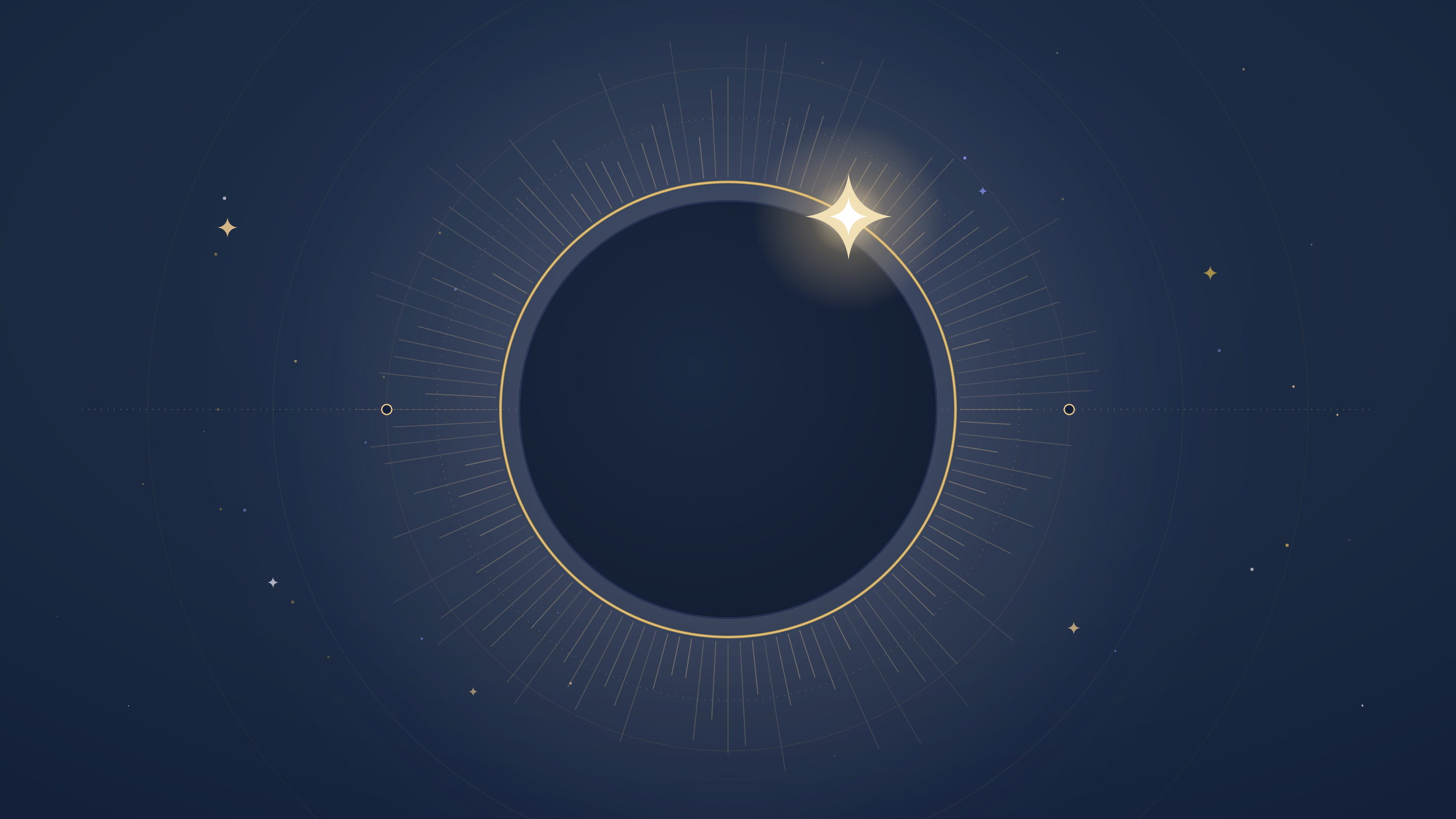
Eclipses have a reputation, and for once the reputation is earned. They tend to line up with the biggest turning points in our lives — the changes, the endings, the beginnings that arrive out of nowhere. If you’ve had a time in your life that felt like it grabbed you by the ear and dragged you somewhere new and unexpected, there’s a good chance an eclipse was involved.
But most of what gets written about eclipses skips the mechanics entirely, which is a shame, because the mechanics are where the meaning lives. A solar eclipse and a lunar eclipse do very different things. A north node eclipse pulls you forward; a south node eclipse asks you to let something go.
Knowing which is which changes how you read one and whether it’s going to matter for you at all.
So here’s your full eclipse guide. What makes an eclipse, the different types, and how to tell whether the next one is speaking to you or just passing through.
Eclipses can be categorised in different ways:
We can have a Solar eclipse (which always occurs at a New Moon) or a Lunar eclipse (which always occurs at a Full Moon).
We also have either South Node or North Node eclipses.
Eclipses can be total, annular, partial or penumbral.
1 — Solar or lunar eclipse?
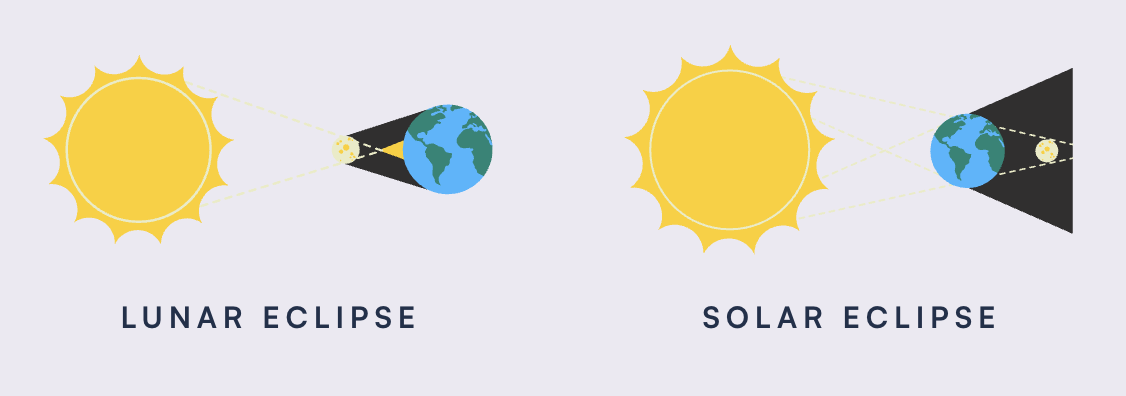
Solar eclipse: this is an astronomical alignment where the Moon passes directly between the Earth and the Sun, temporarily obscuring all or part of the solar disc, only happening during a New Moon phase. Therefore these carry New Moon energy — important endings and new beginnings. One door closes, another opens.
Lunar eclipse: this is a precise alignment of the Sun, Earth, and Moon when the Moon passes through the Earth’s shadow zones, during the Full Moon phase. Therefore these carry Full Moon energy — culminations, results, concrete progress. Lunar eclipses tend to hit harder on a personal level.
2 — north or south node?
Lunar nodes are a major part of the eclipse story. They are not planets, but are the two points where the Moon’s orbital path crosses Earth’s orbital plane (the ecliptic). Eclipses happen only when a New or Full Moon lines up precisely with these nodes. We have a North Node and South Node, which are always in exact opposition to each other.
A North Node Solar Eclipse is future-oriented, offering an invitation to step outside our comfort zone and allow new energy in. An example is a global event that forces us to change our career or to move to a different location.
A South Node Solar Eclipse comes with fated new beginnings which are connected to events in the past, or with new beginnings that depend on a big energetic release. They often come with a choice, where we are offered something new, but we have to let go of something else. An example is a career promotion — we are offered something that is connected to our previous efforts, at the same time, we may need to move offices or change our responsibilities.
A North Node Lunar Eclipse comes with a culmination which creates new possibilities. Examples are making an existing relationship official, or launching a book we’ve been working on for a while.
A South Node Lunar Eclipse comes with a release, and a final outcome based on your personal karma. Examples are getting an inheritance or a health diagnosis that forces us to change our habits.
The exact degree of the node dictates the exact degree of the eclipse — the closer to the exact degree, the more powerful the eclipse.
3 — type of eclipse?
The total and annular eclipses are the most powerful categories of eclipses.
During a total solar eclipse, the Moon is close to Earth and blocks the Sun completely. Day turns dark and this can only be viewed from a relatively small area of the world.
During a total lunar eclipse the whole Moon goes into Earth’s dark umbra shadow. It often turns red (aka a “blood moon”) and it’s usually visible from anywhere on the night side of Earth.
Annular eclipses only occur with solar eclipses. This is when the Moon is far from Earth and looks small. It leaves a bright ring of light (a “ring of fire”).
A penumbral eclipse is a subtle lunar eclipse, where the Moon passes solely through the faint, outer part of Earth’s shadow called the penumbra, causing a very slight dimming.
A partial eclipse can happen with both lunar and solar eclipses, and the alignment of the Sun, Earth, and Moon is not exact so you see a crescent shape taken out of the Sun (solar eclipse), or a dark shadow creeps across part of the Moon’s face (lunar eclipse).
Should you manifest during an eclipse?
No — and this is one of the few times I’ll be that blunt about a trend. An eclipse is a period of chaotic, low-visibility energy. The light is literally being eclipsed, and that’s not the moment to be setting careful intentions you want the universe to see clearly. Sit with what’s surfacing instead. Manifest at the next clean New Moon.
in your birth chart
Eclipses are transits, and we have four a year. Knowing if or how they influence you and your chart is worth knowing. Eclipses are one of the 3 things to look at for major life changes and redirections in a given 12-18 month period.
But, only when an eclipse activates an angle or personal planet in your birth chart is it highly relevant and likely to bring about major changes and events. An eclipse in an empty house, or say 15º away from a placement in your natal chart, usually won’t be that relevant.